Saturday, September 24, 2005

Brown-Butter Whole-Wheat Shortbread


I've told you before, I'm sure, about one of Ben's classmates, and how years ago, when they were mapping out their hearts for a school project, she had divided her affections among all the usual stuff (family, animals, TV, the earth, candy) and then devoted a large section to "really strong wind." And I am so with her on that. Maybe it's people who tend to be agitated who love the wind the most: we think, "Well, at least it's not just us!" Everything blowing around actually makes us feel stiller and calmer by comparison.

That's what I feel like today: weather, weather, and more weather--and I love it. The maple tosses its reddening branches around in the sleet, in the driving rain, the lichen glowing silver against the soaked bark. The heaps and piles of snow dissolve into wind-rippled pools in the driveway. The rain slashes one way; it slashes another way; the sky lightens and then suddenly darkens. Ice crashes from roof to ground. I don't know. I mean, I'm not crazy: if you offered me 75 degrees and sunny, I'd doubtless take it. But I don't think I'd actually be happier than I am right now.

And I'm mentioning that today because these cookies? They are simply amazing--wheaty and buttery, gritty and salty and sweet--but if what you're wanting is the temperate weather of plain shortbread, then don't make them this way. They are not docile melt-in-your-mouth cookies; they are dark-and-sandy never-a-dull-moment cookies. And that is not a polite way to say that kids won't like them, by the way: Ben and Birdy are totally insane for them. They practically weep with gratitude over the browning butter smell, and I think they are starting to shift, as am I, from feeling like wheat flour is a righteously wholesome burden to feeling like whole-grain cookies and breads are actually more delicious than their white-flour cousins (with the exception of baguettes, which we all crave). However, if you make the shortbread with white flour and unbrowned butter, you will not be disappointed, as that is my mother's recipe, and her shortbread is legendary for its simple perfectness. Maybe you should try it both ways, just to see. Besides, it couldn't be easier to make.

Brown-butter Whole-wheat Shortbread
Makes 16 wedges
Active time: 10 minutes; total time: 1 hour

If you'd like to make these more conventional, use softened butter, and white sugar and flour, and proceed from the second paragraph. They will be delicious that way. And I want to note here that you should be storing your whole-grain flours in a container in the refrigerator. You know that, right? Because otherwise the oils in it will get rancid and the flour will taste off and then everyone will think they don't like whole wheat flour, which isn't true.

2/3 cup salted butter (11 tablespoons)
1/2 cup sugar, ideally something grainy (I used a fairly coarse organic sugar, but something like turbinado or muscavado would be great) to emphasize the grittiness
1 1/2 cups whole wheat flour
1/2-3/4 teaspoon salt (depending on your taste for salt, but do use at least 1/2 teaspoon of kosher, or half as much table salt, since the salty-sweet combination is what really makes this)
 
Start by browning the butter: put it in a small- to medium-sized pan (ideally light-colored--mine isn't--so that you can see the color change) over medium-low heat. Let the butter melt, then continue cooking it, swirling the pan constantly, until the butter gets golden-brown and smells nutty, another 3 or 4 minutes. Err on the side of underdone since it will cook for a bit longer after you turn the heat off. For some reason, mine foamed, then relaxed, then suddenly foamed up again right as it was getting done. Weird. Pour the butter into your mixing bowl and let it cool to room temperature (stick it in the fridge for a few minutes if you like).

Heat the oven to 325. Cream together the butter and sugar until, um, creamy, about 2 minutes. Because the butter was melted, it probably won't get fluffy, but ideally it should look smooth and blended and opaque rather than, say, clear and greasy. Now add the flour and salt and mix until the dough starts to clump together and you don't see any dry patches, about 1-2 minutes.

Scrape it into a 9-inch glass pie plate or metal springform tart pan, then use your fingers to pat it down firmly and evenly. Prick holes all over the top with a fork or a toothpick, then use a sharp knife to score the shortbread into 16 wedges.

Bake until deeply brown all over, 45 to 50 minutes, then remove it from the oven and cut immediately in the pan, retracing your lines with a sharp knife. Let cool completely in the pan before storing airtight.

Cozy Noodles with Ham and Peas


I know that all you really want at this point is a recipe for a nice cold glass of seltzer. Believe me—I hear you. I’m like the Smurf balloon in the Macy’s Thanksgiving Parade, only what came out of the helium tank was actually mashed potatoes and linzer cookies and Prosecco. And yet the children still expect to be fed! It’s baffling. I want to say: my God, kids, haven’t you eaten enough? And yet, strangely, their bodies do not take a storage approach to meals. In fact, Ben just wandered past with 6 inches of ankles dangling bonily from beneath his pajama cuffs. It’s no wonder.

And so, in the likelihood that you are still wrangling a fridge full of leftovers into actual lunches and dinners, I’m giving you this easy, delicious pasta with ham and peas. It’s creamy and comforting, with a tiny bit of zing from lemon, and a tiny bit of crunch from butter-toasted bread crumbs. Plus, it’s so blandly appealing that you’d have to be a real Scrooge not to like it—although in that case, perhaps the ghost of the hot sauce bottle could relieve you of your misery. We actually ate it for lunch: when we’re all home all day, I like to serve a large meal midday and then, come dinnertime, we can sit around the living room nibbling cheese and crackers and fruit, or hummus and carrots and pita chips while we play Qwerkle and Bananagrams and do jigsaw puzzles and finish the Prosecco. Oh, I love holidays.

If you don’t have leftover ham, you could make this with deli ham (just cut it into strips, or else have them slice it thick and then you can dice it), with cooked bacon, with leftover turkey, or utterly meatless. It will still be good. But our ham? I don’t know what to say about our ham, except that we had to get on a wait-list at Pekarski’s Smokehouse to get it, and maybe its hard-wonness made it all the more succulent. Or maybe it was just insanely good. “Please please please,” I said to Mrs. Pekarski over the phone. “Our friends? Who used to be turkey-eating vegetarians? Well, I just found out that they actually eat ham now? And we really really need a Pekarski’s ham.” After we got the call (some lunatic had canceled their ham order), we flew to the shop, and Mrs. Pekarski said, “Oh, you’re the one that was so desperate! I got off the phone with you and I said, ‘We gotta get this girl a ham.’” I am blessed to be so well understood.

And please—feel free to share more ideas for leftover ham, seeing as how we still have lots of it. My parents actually took some home with them, and even they had to make soup from the leftovers left over from their leftovers. Proving, somehow, that they never should have left us.

Cozy Noodles with Ham and Peas

If you don’t have egg noodles, swap in another pasta shape—fusilli or wagon wheels, say—but don’t use a full pound or there won’t be quite enough sauce.

3 tablespoons butter (divided use)
1 small onion, finely diced
½ cup fresh breadcrumbs (made from crumbling or blending a slice of white or wheat or French bread, preferably a bit stale)
12 ounces wide egg noodles
¾ cup chicken broth
1 cup cubed or sliced ham (nobody will complain if there’s more)
1 cup frozen peas
¾ cup half and half
Juice and grated zest of ¼ lemon
Salt and freshly ground pepper
Finely chopped parsley
Freshly grated parmesan

Stick your pasta bowls in a 200-degree oven to warm while you prepare the pasta. Begin by bringing a large pot of water to a boil and salt it heavily (I use about a quarter of a cup of kosher salt, but you could use half that amount of table salt). Taste it—it should taste as salty as seawater. And really, I can’t stress this enough: if your cooking water isn’t heavily salted, the pasta will stubbornly insist on remaining bland, no matter how much tasty love you lavish on it later. By contrast, well-salted pasta is almost always good, even if it is imperfectly sauced. Okay. I see that you’re drifting off during my little salt lecture. I’ll move along.

In a wide pan over medium-low heat, melt two tablespoons of the butter and sauté the onion until it’s very soft and starting to turn golden, around ten minutes. Meanwhile melt the other tablespoon of butter in a very small pan, and fry the breadcrumbs over medium heat until they are brown and crisp. Scrape them into a bowl when they’re done, so they don’t burn in the still-hot pan while you’re not looking.

When the onions are done, dump the noodles into the water and give them a stir. Now add the broth, peas, and ham to the onions, turn up the heat, and boil vigorously until the broth is reduced by about half (i.e. there is much less of it left in the pan), then add the half and half and continue to boil the sauce while you season it with the lemon zest and juice and salt and pepper (taste it first—the ham may add enough salt). Turn the sauce way down low while you drain the pasta, which should be done right about now. Stir the pasta into the sauce, stir in the parsley, and taste: does it need anything? A little salt or pepper or a little more lemon juice or zest? When it is perfectly delicious, serve it in the warm bowls and pass the cheese and breadcrumbs.

Friday, September 23, 2005

Whole-Wheat Pasta with Chickpeas and Lemon


So, I finally found out why my kids like chickpeas so much. I mean, I love them myself, but I always feel like they're kind of hard to get to know--tenderhearted and well-meaning, sure, but standoffish in a dusty-tasting and mealy sort of way. And yet, the kids have always eaten them, which thrills me, because chickpeas are a SUPERFOOD! Not just a good food, oh no, no sir, but a SUPERFOOD! What counts as a SUPERFOOD! exactly? Good question. Anything that is just crazy nutrient-dense and/or written up by the New York Times and/or listed in the "Ten Best Foods" in the Sears and Sears Family Nutrition Book, not that anyone could ever stop co-sleeping in their house for five minutes to prepare a proper a meal (Just kiddin', William and Martha! You know we love you.). We are way, way into blueberries and beets, kale and almonds, pumpkin seeds and lentils, red cabbage and tofu and brown rice and mangoes. And chickpeas.

Which, it turns out, as Ben put it so delicately, "Look just like someone's butt. With a crack and everything. We should call them butt peas!" And the boy has a point. So I'm thinking that this might be a great way to sell this dish to your kids: Macaroni with Butt Peas. If that doesn't do it, then use the stepping stones approach: remind them that they loved the roasted chickpea snacks and the macaroni and cheese you already made, then convince them that this is like a delicious amalgamation of those two things. Alternately, if they hated the roasted chickpea snacks and/or macaroni and cheese, Taser them so that they forget.

The thing is, when I don't know what's for dinner, I often put a large pot of water on to boil, and then I look in the cupboard and freezer to figure out what I can put over pasta. Chickpeas, which retain their shape without going mushy, are perfect for this--also because they are protein-rich and nutrient-laden, and because the sauce cooks in the time the pasta does. But I have some opinions about the proper way to make, as we put it around here, "Something out of nothing." It is not as easy as opening a can, though it is not much more complicated than that. It's just that if you're going to make something super-simple, it's got to be really well seasoned and you have to pay special attention to a few details--otherwise it's going to be punishingly bland and cardboardy, and your kids are going to moan and groan and demand a precise bite count so they can please be excused quickly to fling themselves to the ground in disappointment. Is all I'm saying.

So, in case this is ever handy, here are a few secrets to simple pasta dishes. You'll notice a lot of the usual suspects here--ingredients I mentioned in the egg noodles and ham dish. These are, I think, key elements of any pasta dish that does not have an otherwise star-studded cast:
  • See if you can get your family to eat nutritious pasta. We struggled for years because nobody liked whole-wheat pasta ("Hello, particleboard!" as Michael used to say), and regular pasta is so thin on wholesomeness. And then Bionaturae came into our lives, and we love it. (By "we,"of course, I mean "I.")
  • I know I always say this, but: salt the pasta water heavily. Don't do it because it raises the boiling temperature, or lowers it, or some other equivocal physics-style reason. Do it because if you don't, the pasta will be bland no matter what else you do to it, even if you later sauce it with manna imported directly from heaven. An Italian rule of thumb is that the pasta water should taste as salty as the sea; this looks like a large and heavy handful of salt poured from the spout of the box, not like a dainty flurry sprinkling from the shaker.
  • Butter the hot pasta. Even if it's with only a tablespoon of butter, like I'm recommending here. It gives such a nice base flavor to the dish, even if you're simply pouring on a canned red sauce.
  • If lemon is a component of your pasta dish (or of any dish, for that matter), consider adding some of the grated zest along with the juice. The juice adds a pleasant tartness to recipes, but it's the zest that really makes a dish sing of lemons.
  • Keep an eye on the color situation. Here, I like the flavor of chopped parsley, but I'm also adding it for the dash of green to liven up the beige scene. If you have no herbs on hand, consider chopping the leaves from inside a bunch of celery or adding a handful of a salad green like arugula or baby spinach.
  • Likewise, keep a tooth on the texture situation. Fried breadcrumbs aren't essential here, but they are an easy crunch fix for any dish that is in danger of a certain relentless softness under the molars.
  • Use freshly grated parmesan and plenty of it. We buy blocks of parmesan at Trader Joe's, and the kids grate it on a microplane grater as needed.
  • Make sure the pasta stays nice and saucy. In a simple dish like this, that means plenty of olive oil and the liquid from the canned chickpeas. If the liquid in your can looks creepy or tastes tinny--I sometimes find one or another of these things to be the case--then use chicken broth instead. 
  • Heat the plates. I know that I sound suddenly like Queen Fancy Pants of the Many Complicated Advices, but it's so easy to warm the plates--I stick them in a 200-degree oven when I add the pasta to the water--and it prevents that whole pasta-congealing-on-a-cold-plate situation. I don't always do this, but I'm always glad when I remember to.

Whole-wheat Pasta with Chickpeas and Lemon
Serves 6
Total time: 20 minutes (not including boiling the water)

This recipe takes well to the addition of some chopped, cooked greens, dumped in with the chickpeas. The truth is that I pulled a bag of chard out of the freezer and then found it again, thawed but unopened, after dinner. The pasta was still very good without it. If your family cannot be persuaded by whole-wheat pasta, then use the healthiest pasta you can get away with. Also, if you can't bother with the breadcrumbs, this will still be very tasty. Classic pantry food.

2 tablespoons butter, divided use
1/2 cup fresh breadcrumbs (made from crumbling or processing a slice of white or wheat or French bread, preferably a bit stale)
2/3 pound whole wheat pasta (I cooked an entire pound of Hodgson Mills macaroni, buttered all of it, and then left some of it out of the sauce, in case kids wanted "plain seconds," which they didn't)
1/4 cup olive oil
2 cloves garlic, pressed of finely minced
1 15-ounce can chickpeas with their liquid or, if the liquid doesn't seem tasty and nice, with 1 cup of chicken broth
Juice and grated zest of half a lemon (around 2 tablespoons of lemon juice and 1/2 teaspoon zest)
1/2 teaspoon kosher salt (half as much table salt) or more or less to taste
Freshly ground black pepper
1 tablespoon butter
1/2 cup chopped parsley
1 cup freshly grated parmesan, plus more for serving

Bring a large pot of heavily salted water to a boil while you prepare your other ingredients. Such as the fried breadcrumbs: melt one tablespoon of butter in a very small pan, and fry the breadcrumbs over medium heat until they are brown and crisp. Scrape them into a bowl when they’re done, so they don’t burn in the still-hot pan.

Begin cooking the pasta and pop your bowls or plates in a 200-degree oven.

Now heat the oil over low heat in a wide pan. Add the garlic, and stir it around a bit until it is fragrant but not coloring, then add the chickpeas and their liquid or broth. Turn the heat up a bit to simmer the chickpeas, and add the lemon juice and zest, the salt, and a bit of freshly ground black pepper.

Let the chickpeas simmer gently while you drain the pasta, which should be cooked around now--taste it and see, and save a cup of the cooking water, in case the sauce needs it. Butter all of the pasta with the remaining tablespoon of butter, then dump about 2/3 of it into the pan with the chickpeas. Stir it all together, add the parsley and parmesan, then stir it again. Now taste it: does it need a bit more liquid? (Add some broth or pasta cooking water.) More lemon or salt? It should be very tasty and saucy.

Serve in the warmed bowls with parmesan and breadcrumbs for passing.

Baked (but gooey) Macaroni and Cheese


Sometimes you need to offer a comforting dinner. For example, say baby Anna comes to visit your house on the banks of plum creek and she tears up all the paper dolls so you tell Laura to let her play with Charlotte, her beloved rag doll, only then Anna doesn't want to give Charlotte up, and so you insist that Laura's too big for dolls anyways and you make her give Anna the doll, which you later find abandoned in a thawing mud puddle? That kind of day? Exactly.

Okay, so maybe the child's name was Birdy and not Laura, and the toy in question was not Charlotte (which is, oddly, the name of Birdy's doll too) but a set of Sesame Street Aqua Doodle Mini Mats. Still. There are days when I can't quite believe myself. I mean here's Birdy, who had practically been babysitting our friends' toddler for two days, offering him an endless and good-natured supply of entertainment and activities and toys and attention. And then I have to go and offer a toy she's not ready to give up, for him to take for keeps. When she balked, I hissed at her ("I haven't seen you use that toy in years!" "No, Mama, it's not true, I do actually still use it!), and then finally agreed that she could keep the Sesame Street Aqua Doodle Mini Mats--but in a way that took more than it gave back, if you know what I'm saying. Poor Birdy. She was so miserable, and I had to shake myself by the shoulders to rouse my dozing compassion. "I'm sorry I made you feel bad," I finally said, and meant it. "It took me a while to get over my own idea about what should happen, but now I see that you were right to speak up about what you wanted, and I'm glad you did. You are a really generous friend." Birdy slumped against me in tearful relief, and I felt like a gigantic calloused heel that no Ped Egg on earth was ever going to smooth over.

What does any of this have to do with macaroni and cheese? Well, on a Sunday afternoon when a gentle, misty rain is falling and the world is green and lovely but also a little end-of-the-weekend melancholy, it seems like macaroni and cheese is called for. And while the boxed kind is fine for lunch--"cheap and cheerful," as my mum would say--it has never struck me as a very good dinner, although that may be because I just don't love it. It's not snobbery, and don't get me wrong, I'll happily enough eat a bowl of Annie's or Trader Joe's macaroni in a pinch, but I don't really understand why kids treat it like the blue jeans of the food world--this kind of versatile and universally appreciated thing--when boxed mac and cheese always seems kind of powdery and barfy-smelling if you ask me. But maybe that’s because I grew up on Stouffer's Macaroni and Cheese, which I still take to be the last word on molten deliciousness. (Could it be because--I just Googled this--one 6-ounce serving has 16 grams of fat? Could that account for the unearthly yum factor? Could be.)

And so I offer you this homemade approximation of Stouffer's that is super-easy and super-tasty--beautifully browned and crispy outside, and perfectly creamy and unctuously cheesy inside--if not exactly wildly nutritious or inexpensive. Still, because you don't need to boil the macaroni first, it doesn't create a zillion dirty dishes, and it cooks in the oven, which means none of that last-minute boiling and draining. I know I must seem like the Sybil of the recipe world--as if I have multiple food personalities, and one of them is Michael Pollan and the other is Rodney Dangerfield. But that's kind of how it is for me. We think a lot about where our food comes from and how and by whom it gets produced and distributed--and then also there's an occasional straying towards Velveeta. Which is, as you may know, a "shelf stable" cheese product. The second ingredient of which is water. Which is not bad for you, of course, water, but it's not really what you expect your cheese to be made out of.  Oh, but the way it melts! So smooth, so orange. If you use Velveeta and have leftovers, melt some in the microwave with bottled salsa, then scoop it up with tortilla chips. This is the chili con queso dip that Avra Jordano's mother made in a crockpot for my surprise sweet-sixteen party, and it's the thing I have craved every day of my life since. But if you can't bring yourself to use Velveeta, or half Velveeta, like I do, then use all cheddar and allow your righteousness to distract you from the slightly grainy texture of your macaroni and cheese. It will still be yummy.

In the end, I figure the Velveeta and the local milk delivered in a glass bottle kind of balance each other out here. Right?

Baked (but gooey) Macaroni and Cheese
Makes 6 large servings
active time: 15 minutes; total time: 1.5 hours

Adapted from the recipe "Creamy Macaroni and Cheese," printed in the New York Times on January 4th, 2006. That recipe uses nutmeg, cayenne, and dry mustard--but the flavors of the Frank's hot sauce and the bit of wet mustard are exactly what I'm wanting in a pan of mac and cheese. A "bloop" is something like a half a teaspoon--which is probably the same amount, actually, as "a few good shakes." Use regular elbow macaroni for this: I don't know that whole wheat pasta or other shapes will cook through when baked this way.

2 tablespoons butter, divided
1 cup cottage cheese (not low-fat)
2 cups milk (not skim)
a bloop of brown or Dijon mustard
a few good shakes of Frank's Red Hot, or a not-too-spicy hot sauce of your choosing
1 scant teaspoon kosher salt (or half as much table salt)
1 pound cheese, grated (I use half grated sharp cheddar, half cubed Velveeta)
1/2 pound elbow macaroni, uncooked

Heat the oven to 375, and position an oven rack a third of the way down from the top. Use 1 tablespoon of butter to grease an 8- or 9-inch round or square baking pan (I use a Pyrex pan that is actually 7 by 11 or so--close enough). It's actually easiest just to melt the butter in the pan in the oven, and then swirl it around to coat the bottom and sides.

In a blender, puree the cottage cheese, milk, mustard, Frank's, and salt. Combine this mixture in a large bowl (ideally one with a spout) with the raw macaroni and the cheese, reserving 1/4 cup grated cheese for topping, which you'll do halfway through the baking. Pour into the prepared pan, cover tightly with foil, and bake for 30 minutes. (Unless you love the smell of milk burning on your oven floor, you might want to put a foil-covered baking sheet on the rack beneath to catch any puddles of spill-over. This is an idea I am having only in hindsight, if you know what I mean.)

Uncover the pan and stir gently, redistributing the pasta and sauce evenly, and unsticking any macaroni that has attached itself to the pan. Dot with the remaining butter, sprinkle with the remaining cheese, and bake another 30 minutes, at which point it should be well browned and beautiful. Cool for 15 minutes before serving.

Perfect Sautéed Chicken with (or without) Mushrooms


It is hard to describe my relationship to chicken. I eat it and like it, sometimes very much. But cooking it? "Heebie jeebies" is a serious understatement. I dread wrangling it out of its wrapping, wrangling various wrapped bits of its insides from inside of it. And the whole time I'm stopping to scrub my hands with soap and water approximately every nanosecond. Then I wash the tap that I may or may not have contaminated with my contaminated chickeny hands. (I don't even know if it's salmonella I picture exactly, or Bubonic Plague, or just a generalized kind of poisoning, the skull-and-crossbones-on-the-label kind, like Drain-o). Then I go grimacingly back to the chicken itself, wedging my hand in here and there like a poultry remake of something you might have seen, if you grew up in New York in the eighties, on channel J.

Hm. As always, I worry that I have not transitioned seamlessly from a confessional writer to a food writer. Anyways. I will soon be posting recipes for some of our favorite chicken dishes: a simple, perfect roast chicken, for one, and bogglingly good Chinese-style red-cooked chicken thighs, for another. Both of these recipes are straightforward, and each requires only a bit of time and, yes, a bit of the requisite this and that with the raw parts.


Today, however, we're going to be dealing with the kind of chicken that basically leaps, pre-wrangled, from package to pan: boneless, skinless breasts. Now, the fact that you can buy them, like cotton balls, dry-frozen in a huge Ziploc should be your first clue that this is not a real back-to-the-earth food. It's like buying a bag of fish-tank gravel from the pet-supply store. It's like buying a bag of doll parts at the flea market--not that we actually bought it, but we did see it: all resin limbs, flesh-hued arms and legs, in a 50-cent Ziploc that made Birdy literally shudder. "I love dolls but I so don't want to buy that!" she said, and we said, "Okay!" (Actually, we said, "Well that's too bad, because you have to buy it!" and then felt bad because she didn't realize we were kidding and a look of abject horror passed over her rosy features).


Where was I? Have I mentioned yet how absolutely delicious this recipe is? No? Well let me mention it now: properly sautéed chicken breasts--using enough heat and enough fat--are completely excellent, and I'm going to offer you a sort of tutorial here for just that. You can do what you like with them when they're done: make the simple pan sauce and eat them as is, or slice them up to top a salad or pasta or to fill sandwiches or burritos. But the idea here is that it's dinnertime and what you need to make is dinner and there's no time for brining or braising or marinating. I'm showing an optional accompaniment of sautéed mushrooms because I happened to have them, they happen to go well with chicken, and they happen to be beloved by 3 out of 4 people in my household. The fourth person will gamely try one every time they're offered by nibbling a microscopic corner off of one and then nearly fainting from revulsion. Because mushrooms feed off of dead and decaying things and also poop, I take this fainting revulsion to be reasonable.

A few tips:
  • Use very small chicken breasts or else cut each one in half to make 2 skinnier breasts. Thick breasts take too long to cook, and the middle insists on remaining bland. You could also pound them, but pounding meet always makes me feel like I'm in one of those grisly Roald Dahl stories; this may be my own personal quirk.
  • In a non-stick pan, the chicken may be disinclined to brown correctly, and the brown is where the flavor is here. Try to use a non-non-stick pan.
  • Use a mix of butter and oil: butter for flavor and oil to keep the butter from burning.
  • Don't be afraid of heat. You want to brown the chicken very well, and you want to do this before the inside turns to quilt batting. The chicken will seem, at first, like it's sticking, but once it's properly browned it will loosen almost as if by magic.
  • If you're photographing the chicken with a digital camera that you don't know how to use, then don't forget what you're doing and grab the hot, hot handle of the pan with your bare hand.
  • Adapt as you will: add small amounts of chopped herbs (rosemary, say, or tarragon) to the pan sauce; add lemon juice and capers to the pan sauce to make a version of a piccata (we make it this way a lot).
  • Slice each breast up crosswise before serving: this allows the sauce to get all over the bland inside, and also it's just much easier and more appealing to eat, for kids and grown-ups alike.

Perfect Sautéed Chicken
Buttered egg noodles make a great accompaniment, since the delicious juices seep over on the plate and season them perfectly.

1-1  1/2 pounds small boneless, skinless chicken breasts (4 or 5)
Kosher salt
1 tablespoon olive oil
1 tablespoon butter
1/2 cup dry white wine and 1/2 cup chicken broth (or just use 1 cup chicken broth or another tasty liquid of your choosing if the wine is going to be too wine-y for your kids)
A bit of chopped parsley

Begin by trimming the chicken breasts if they need trimming. I use my beloved kitchen scissors and snip off any shaggy bits of fat or gristle (even writing that now, I shuddered). If the breasts are large, take a large, sharp knife and cut each one parallel to the counter so that you end up with 2 skinny chicken breasts where once there was one thick one. Pat them dry with paper towels (this helps them brown) and sprinkle them with some kosher salt (I keep salt in small bowls and find it much easier to use that way).

Meanwhile, heat a very large pan over medium-high heat and add the butter, which should melt and foam, and the olive oil, which should stop the butter from burning. When the fat is all very hot but not turning black (recipes say "when the foam subsides"), add the chicken breasts in one layer. Now leave them alone for 5 or so minutes while the bottom gets nice and crusty and brown (if they seem at all disinclined to brown, then turn the heat up and leave them until they do). Use tongs or a spatula to flip them over as they're ready for flipping, and then cook another 4 or so minutes until the bottom is very brown and the chicken is cooked through: you may want to cut a piece open, but try pressing a cooked breast with your fingertip so that you get a feel for its doneness, which will develop over time into the skill of knowing when it's done without cutting it.

Pile the chicken on a heat-proof plate and pop it into a warm (200-degree) oven while you "deglaze" the pan: pour the wine in and scrape with a spatula to dissolve all the yummy browned bits while the wine bubbles and boils furiously in the hot pan. When the wine has cooked down about halfway, add the broth, turn the heat to high, and cook until the sauce seems syrupy and delicious. Taste it for salt, then drizzle it over the chicken, sprinkle with parsley, and serve. Sometimes, if the chicken has browned but doesn't seem quite cooked through, I leave it in the pan while I make the sauce so that it can simmer in there a bit longer; this is a perfectly fine way to do it.

Bonus Optional Sautéed Mushrooms
2 tablespoons butter
3/4 pound mushrooms, sliced
salt
optional: pinch of thyme and a bit of chopped shallot
1/2 cup wine (or broth)

In a cast iron pan, or another wide pan that's not non-stick, melt the butter over high heat. When it is very hot, add the mushrooms and a pinch of salt, and give them a toss and a stir to coat all the slices with butter. Now leave them alone for a few minutes while they begin to cook and release a lot of juice: they will look very unpromising at this point, like a panful of pale mushroom stew. Have faith! Stir them occasionally as the liquid begins to cook off and, after ten or so minutes, the limp mushrooms will be back to frying again, turning nice and golden and brown in the pan. At this point, add the optional thyme and shallot and a bit more salt as you see fit, and, when all is very browned and fragrant, pour in the wine or broth which will sizzle and steam furiously. Stir the pan as the liquid evaporates, then serve the perfect mushrooms to anyone sane enough to love them.

Mexican Chicken Salad with Buttermilk Lime Dressing


Is it hot hot hot where you are, like it is here? All anybody wants to eat is fruit and popsicles and salad. Well, also Twizzlers and potato chips and soda and cotton candy and bubblegum chewing tobacco, but you know what I mean. I am reminded suddenly of my teenagerhood: after my brother had already left us for college (sigh) my mom would, on a hot night, sometimes set up the card table in the living room and make a huge salad nicoise that we could eat by the open window. I still think I've never felt quite as grown-up since as I did then, crunching on green beans and tinned tuna in the faint breeze with my beautiful mother, like we were on a sidewalk in Paris waiting for our café au laits--rather than people who were about to retire to the air-conditioned bedroom to watch Taxi reruns.

And my kids, little though they are (Are they? I don't even know anymore.) also love a salad for dinner. It's cold and crunchy and you can help yourself and it just feels like the essence of summer. Of course, it helps if you have a great salad, and this really is one: the dressing is limey and creamy, and it's full of exciting treats: tortilla chips and grilled chicken and corn, and also, if you're Birdy or me, crunchy, delicious radishes. Of course you could change it in a million ways: you could use spinach, say, which would up the nutrients (although my kids think of iceberg lettuce as thrilling junk food, so I love to serve it to them occasionally), you could do steak or ground beef instead of chicken (or skip the meat altogether), you could swap in roasted green pumpkin seeds for the chips (another nutrient-booster), you could add some grated cheddar (I meant to and forgot) or black olives, you can swap in other kinds of beans, add chopped tomatoes, dress it with a mixture of salsa and sour cream like our friend Megan does. Although, I have to recommend the dressing: it's not hard, and part of it doubles as a marinade for the chicken, so it's kind of a two-fer situation. If I were making this for my own self, I would add a bit of chopped red onion.

And that said, I need to confess something: there was an inexplicable epidemic among the children of not eating the chicken. I can't explain it, except to say that we had friends over, one of whom opted out of the chicken, which seemed to set in motion a great and revolted pushing aside of it on everybody's plate. WTF? Limey grilled chicken? And strips of breast, not even legs or thighs with all their creepy tendons and cartilage that might force you to remember the living poultry's muscles at work, dipping and clucking around the chicken yard?  Even Birdy will usually gobble up a piece or two of grilled chicken breast. But not this time. "Chicken is just kind of starting to gross me out," Ben said. Ben who was crunching ravenously through his lettuce like a person starved for lettuce. The same Ben who, as recently as three years ago, would have plucked a nanoparticle of lettuce from his chicken sandwich and said, "Ack! There's salad in here! Somebody take it from me so I can eat my yummy yummy chicken." How they change. But then again, three years ago, I would have gotten up from the table to fetch a pair of tweezers to pluck every last molecule of raw onion from the salad you were serving me. Because it used to be my least favorite food. Only now I love it. So go figure.

Mexican Chicken Salad with Buttermilk Lime Dressing
Serves 6
Active time: 45 minutes, plus some time for the chicken to marinate


Juice of 2 limes (around 1/3 cup) plus the finely grated zest of one of them
2 teaspoons koshers salt, divided use (or half as much table salt)
2 cloves garlic, pressed or finely minced
2 tablespoons chopped cilantro
2 tablespoons olive oil
3 boneless skinless chicken breasts
1/2 cup mayonnaise
1/4 cup buttermilk
1 teaspoon sugar
1 head of iceberg or romaine lettuce, chopped
The kernels  cut from 3 ears of corn (or 1 1/2 cups frozen corn kernels)
1 can of black beans, drained and rinsed
1 large bunch of radishes, sliced
1 avocado, sliced
1/2 a bag of tortilla chips, crushed

Begin by making the dressing and marinade: whisk together the lime juice and zest, 1 teaspoon of the salt, the garlic, and the cilantro. Pour half of this lime mixture into a dish large enough to hold the chicken, then whisk in the olive oil and the other teaspoon of salt; add the chicken, turn to coat it with the marinade, cover it, and refrigerate it for up to 4 hours and for as little as 20 minutes. Now take the remaining half of the lime mixture and whisk in the mayo, buttermilk, and sugar. Taste it--add salt, sugar, or lime as needed--then cover and refrigerate. This is the dressing.

Prepare the corn: bring a tablespoon or so of water to a simmer in a small pan over medium-high heat, then add the fresh or frozen corn and cook, stirring occasionally, until just tender, around 2 or 3 minutes.

When you're ready to eat, heat a gas grill or barbeque and cook the chicken until it is just cooked through, turning it occasionally, around 10 minutes altogether. Set it aside to cool on a cutting board while you assemble the salad.

Spread the lettuce on a very large plate, then add rings of radishes, beans, corn, and avocado. Slice the chicken and arrange it on the top of the salad, then bring it to the table so everyone can see how pretty it is. Add the dressing and chips, then toss and serve.

Saturday, May 21, 2005

Asparagus with Delicious Dip

(Originally posted @2010)


 Hadley, Massachusetts is one town over from us. This is an especially important fact to remember come May because Hadley is the asparagus capital of the world. The world! I know.

It's also where our very good friends live (our friends who are Ben's friend Ava's parents, if you're a long-time reader here). Not surprisingly, given the whole world-capital situation, our friends live across the street from a ginormous asparagus farm. An asparagus farm the owners of which have told them to go ahead and help themselves! Whenever! (They also live across the street from a tobacco farm, but don't worry--I won't be posting any recipes.)

"It's hard not to be greedy!" our friend Nicole said, after walking the kids across the street to pick with her. And then she pulled a gigantic asparagus-stuffed bag out of her backpack. And then another. "Very hard, it looks like," her husband said, and we laughed. But oh they are good.

Don't believe the hype about the skinny ones. Pencil-thin this and that is everyone's favorite, but not mine. I like the big, fat asparagus, which are the sweetest I think. Also, fatness is not a sign of age: while asparagus do get longer as they get older, they poke out of the ground as thin or fat as they are ever going to be. When I was visiting my brother's family a few weeks ago, my sister-in-law ended up having to explain the word "phallic" to my nephew, who had overheard us in the garden laughing our heads off over a particularly well-endowed specimen in the asparagus patch. Oops.

So, now that I seem to have managed to mention both tobacco and x-rated vegetables, it's time to talk about cooking the asparagus before I say something gross about the way it makes your pee smell. I love asparagus roasted in the oven: I toss it with olive oil and salt on a foil-lined baking sheet, then roast them at 450 until they're browning and tender. But when they're super-fresh like this, I find a brief boil the best way to emphasize their mellow sweetness. Plus, this is the way the kids are most likely to eat them. You know what I said last week about salmon? That's how the kids are about asparagus too. Sometimes they love them and sometimes not. Right now they love them. Maybe later in the week I'll post my hollandaise recipe, which is a great way to get kids involved with any vegetable that has them shuddering. But for now, we're going to make this lovely salmon-colored dip that is zingily delicious and insanely easy and also uses some of those chipotles I made you buy for the dinner beans and the tamale pie. (See? Aren't they coming in handy?) This dip is also great with other veggies--raw carrots and blanched broccoli, for example--as well as on sandwiches and in chicken salad. My kids love it, but if it's too spicy for yours, you can always cut back on the chipotles, or substitute some smoked paprika, which is smoky but not hot.

As with all vegetable matter, put this out before dinner when your kids are milling around starvingly. They'll eat it.

Asparagus with Delicious Dip
If you want to serve the asparagus hot, simply omit the dip and the cold-water rinse, then add butter, salt, and a squeeze of lemon juice to taste.

1 or 2 bunches of very fresh asparagus (the bottoms should look moist and freshly cut)
1/2 cup Hellman's or Best Foods mayonnaise (not reduced-fat)
1 tablespoon lemon or lime juice
1 small clove of garlic: cut it open, pull out the green shoot, and then finely chop it or put it through a garlic press
1/4-1/2 teaspoon chipotle puree (see photo at right and instructions here)
1/4 teaspoon kosher salt (or half as much table salt)

Wash the asparagus in a large sinkful of cold water while you bring an inch of water to a boil over high heat in a very wide pan. Now snap the bottom off of each asparagus spear: there will be a place where it naturally wants to break, a couple inches up from the very bottom, and you will feel this if you bend it a bit. Add the asparagus to the boiling water, spreading them out in the pan as best as you can, and cover. Check for doneness starting at 2 minutes: stick the tip of a paring knife into one and see if it feels tender. If not, boil another minute or two, moving them around in the pan with tongs so that they all get a fair shot at submersion. Drain them and run cold water over them until they're cool, then spread them out on a clean dishtowel to dry. Meanwhile you've whisked together the mayo, lemon juice, garlic, chipotle, and salt. Use a cooked asparagus to taste the dip, and re-season it if it needs more salt, chipotle, or lemon juice. 

Thursday, May 12, 2005

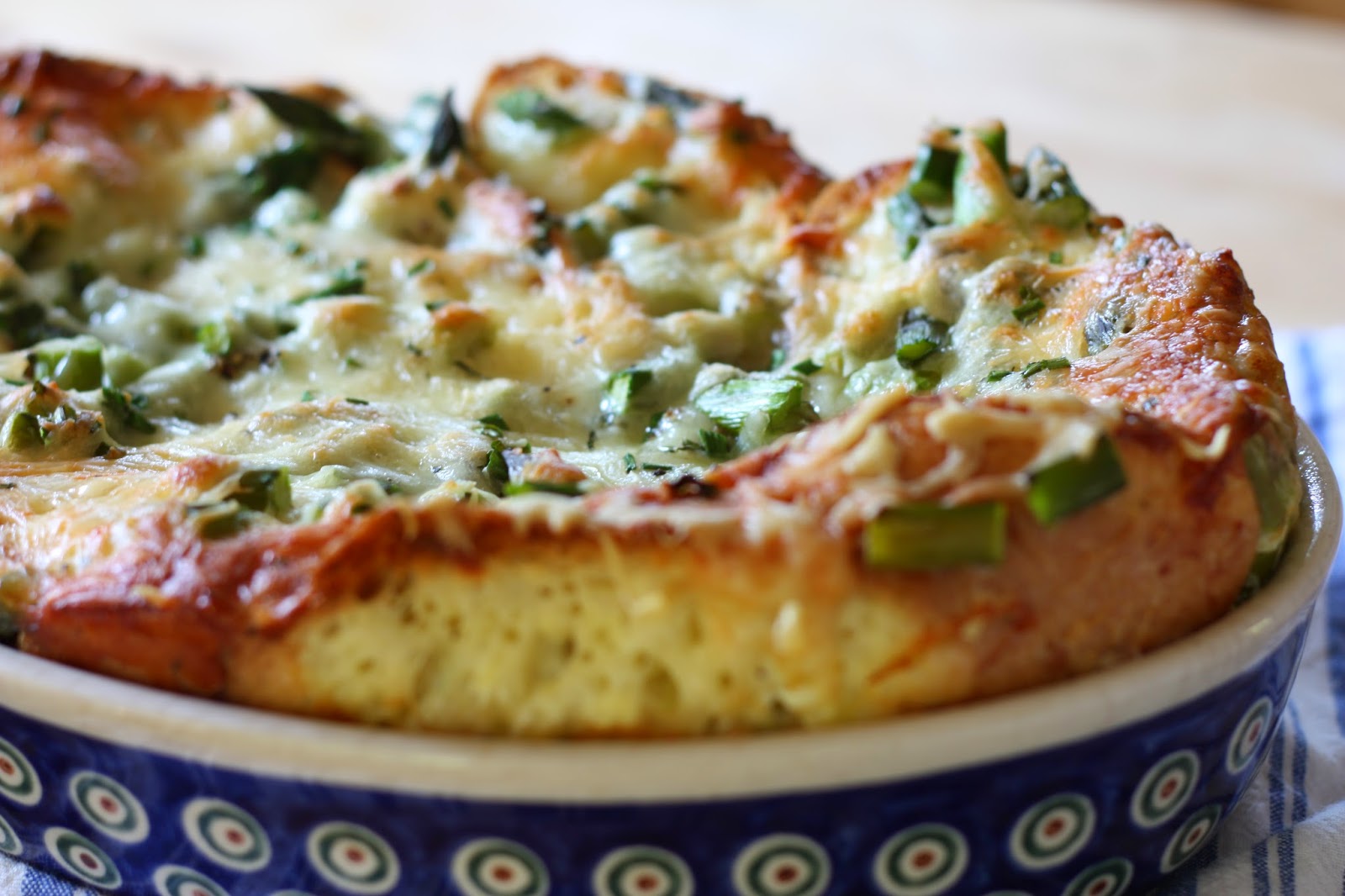
Asparagus Bread Pudding


Asparagus Bread Pudding
Active time: 15 minutes; total time 1 hour
Serves 6

Here, stale bread gets new life as the world's easiest, cheesiest soufflé. Call it "savory French toast" if that will encourage your kids to eat it--and make it in the spring, when asparagus is fresh and plentiful. You could also try using sauteed mushrooms, steamed broccoli florets, roasted zucchini, or whatever vegetables catche your eye at the market. Likewise, although the tarragon and chives go beautifully with asparagus, use whatever fresh herbs your family likes best. Serve the bread pudding with fruit for brunch or with a crisp salad for dinner.


1 loaf of French bread, cut into 1 1/2-inch slices
1 bunch of asparagus, washed, bottoms snapped off, and cut into 1/2-inch pieces
5 large eggs
2 1/2 cups whole milk (or a mixture of low-fat milk and cream or half and half)
2 teaspoons kosher salt (or half as much table salt)
Freshly ground black pepper
1/2 teaspoon finely chopped fresh tarragon
1 tablespoon snipped chives
1/2 pound cheese, grated (try Swiss, cheddar, Monterey jack, or a combination)

Heat the oven to 350 and grease a large casserole dish. Place the bread on a large baking sheet and toast for 10 or so minutes, until it is dry to the touch, but not browned.

Meanwhile, bring a small pot of salted water to a boil and cook the asparagus pieces for 3 minutes, then drain, rinse with cold water, and drain again. Whisk together the eggs, milk, salt, pepper, and herbs.

Arrange the bread slices in the casserole dish, overlapping as little as possible, then arrange the asparagus over the bread, sprinkle with the cheese, and pour the custard over all, pressing down any bread pieces that aren't submerged. Allow to sit for half an hour or so, so that the bread can absorb the egg mixture--or else refrigerate it, covered, overnight. Bake it in the middle of the oven for 35-45 minutes, until it is puffed and brown. Let stand 10 minutes before serving.

Asparagus with Pink-Grapefruit Sauce


Asparagus with Pink-Grapefruit Sauce
Serves 4
Total time: 15 minutes

You might have to lick the platter, and that will have to be okay with everyone--the sauce is just so buttery-rich, but also bright, sweet, and fragrant with citrus. It's a perfect match for tender, springtime asparagus--or for broccoli, green beans, or even fish.

1 large bunch of asparagus (about 1 1/2 pounds)
Kosher salt
1/3 cup freshly squeezed pink grapefruit juice (from 1/2 a small grapefruit)
1/2 teaspoon champagne or white wine vinegar
3 tablespoons butter, cut into 3 pieces
1 teaspoon freshly grated pink grapefruit zest
1/4 teaspoon sugar

Wash the asparagus and bring a half an inch or so of salted water to a boil over high heat in a wide, lidded pan. Now snap the bottom off of each asparagus spear: there will be a place where it naturally wants to break, a couple inches up from the very bottom, and you will feel this if you bend it a bit. Spread the asparagus out in the boiling water, cover the pan, and cook until just tender. (Check for doneness starting at 3 minutes: stick the tip of a paring knife into one and see if it feels tender. If not, boil another minute or two, moving them around in the pan every once in a while.) Once they're done, pull them out of the pan with tongs and lay them out on a dishtowel to dry while you make the sauce.

In a very small pot, boil the juice and vinegar over medium heat until reduced to around 2 tablespoons, 3 or 4 minutes (you can do this while the asparagus cooks). Whisk in the butter, which will start first to melt and then to thicken the sauce. Whisk in the zest and sugar and 1/4 teaspoon or so of kosher salt (or half as much table salt). Taste the sauce for balance--add a drop more vinegar, sugar, or salt if it needs it--then pour the sauce over the asparagus and serve.

Asparagus with Brown-Butter Sauce

(originally posted in March 2010)


The kids are thawing out outside in the thaw, riding their bikes around and around the dirt-breaded mounds of snow like they've emerged from hibernation with a craving for nothing but air. There are many things I miss during the long winter months--the dear sight of their arms and legs, for instance, or the way anybody's nose looks when it's not crusted with snot--but watching them now, out the window, I realize that I've been missing exactly this: the pleasure of seeing them from a distance, silently. Winter is the season of everybody's face an inch away from yours, everybody's fleecy limbs flung across you every minute of every day, every conversation heard and overheard and overly overheard, if you know what I'm saying. I love the closeness and company, I really do, but right now that sunlit space between us is like a tonic.

As is the sunlight itself, of course. O, shining sun! I am reborn in your image.

It's just borrowed spring, of course, this early in March. For one thing, the daffodils are imported from England. For another, the asparagus are imported from Mexico. But in these early cheater days of the season, I couldn't help myself. It will doubtless snow another two feet before we get our own daffodils and asparagus. But I don't even care, because it's coming. You can smell it in the morning--that metallic breeze that pours in with all the early light. The children wake with energy spooling through them like they're crazy-straws coursing with metabolic juice. The pussycat bounds around like he's a furry four-footed clown with springs for legs.

So asparagus, of course. The first ones must be eaten standing up, at the counter, leaning over the plate like you are dying from a hundred vitamin deficiencies and have torn the green shoots from the mud with your own bare and scurvied hands. And you know how I am about kids and vegetables. How I am is: butter. A little butter is a perfectly wholesome thing to eat, and vegetables are massively wholesome, and the two together are an extraordinary match. Why force children to experience vegetables as a punishment? "A plate of plain steamed broccoli! Eat it. Maybe next time you'll think twice before needing vitamins!" Here, the butter is swirled over heat until it is toasty-looking and so lusciously fragrant that you will be practically slavering into the pan. Of course browning butter is not exactly a straw-into-gold scenario, since butter is heavenly to begin with. But try it, and see if you can't get your kids to love some green something that they weren't so sure about before. Mine are up and down with asparagus--by the end of the season, they'll think it's maybe kind of revolting--but to say that the platter was licked clean would not be figurative in this case. Or, to quote my delightfully insane son: "This is so not aspara-gross!"

Asparagus with Brown-Butter Sauce
Serves 4
Total time: 15 minutes

I've said this before, but I like fat asparagus: they're no older than skinny ones--and I think they're sweeter and juicier and just yummier overall. But these were pretty skinny, and they were wonderful too.

1 pound very fresh asparagus (the bottoms should look moist and freshly cut)
Kosher salt
4 tablespoons butter
1 teaspoon freshly squeezed lemon juice

Wash the asparagus and bring an inch or so of water to a boil over high heat in a very wide lidded pan. Now snap the bottom off of each asparagus spear: there will be a place where it naturally wants to break, a couple inches up from the very bottom, and you will feel this if you bend it a bit. Spread the asparagus out in the boiling water, and cover them. Check for doneness starting at 2 minutes: stick the tip of a paring knife into one and see if it feels tender. If not, boil another minute or two or three, moving them around in the pan with tongs every once in a while. Once they're done, pull them out of the pan with tongs and plunk them on a dish towel to dry while you make the brown butter sauce.

Now, theoretically, you could already having been making the sauce while the asparagus was cooking, but honestly it's all so quick anyway that I recommend doing one thing at a time--you don't want to overcook the asparagus or burn the butter, both of which are fairly easy to do. Now: put the butter in a very small pan (ideally light-colored, the photos of my black pan notwithstanding, so that you can see the color change) over medium low heat. Let the butter melt, then continue cooking it, swirling the pan constantly, until the butter gets golden-brown and smells nutty and swoonish, another 3 or 4 minutes. Err on the side of underdone since a) it will cook for a bit longer after you turn the heat off, and b) as long as it's not burnt, the butter will be good no matter what.

Put the asparagus on a warm platter (you don't want the butter to congeal) and pour the sauce over it, making sure to get all the yummy brown bits out of the bottom of the pan. Eat. 

Sunday, May 01, 2005

Oven-Roasted Chickpeas


Oven-Roasted Chickpeas


If your children are likely to be skeptical, call them "nuts." Not in a lying way, but in a way where you say "chickpea nuts," only you kind of mumble and swallow the chickpea part and then say "nuts" nice and loud. They are crunchy and salty and addictive, but also wholesome and incredibly satisfying. If curry isn't your seasoning, try something else: just the garlic powder, maybe, or some smoked paprika and celery salt. I want to make buffalo chickpeas, and coat them in Frank's hot sauce, dip them in blue cheese dressing. But maybe that's just me. The curry is pretty appealing to the kids we know. Birdy, for instance, gobbles them by the handful. “I love these!” she cries. And then, with her mouth full, clarifies: “But I don’t love them more than cake!” Well, sure.

1 (15-ounce) can chickpeas, drained and spread on paper towels to dry
1 tablespoon olive oil
1 teaspoon curry powder
½ teaspoon garlic powder
½ teaspoon kosher salt or half as much table salt (more if there’s none in your curry powder)


Heat the oven to 400. Heat the oil in a small pan over low heat, then add the curry and garlic powders, and stir until fragrant. Turn off the heat, pour in the chickpeas, and stir gently until they’re coated with the oil and spice. Spread them in a foil-lined rimmed baking pan and bake for forty-five minutes to an hour, shaking the pan every ten minutes or so. When they’re done, some will be brown and crunchy and some will be golden and still a bit soft in the middle and, ideally, none will be burnt.